Error loading page.
Try refreshing the page. If that doesn't work, there may be a network issue, and you can use our self test page to see what's preventing the page from loading.
Learn more about possible network issues or contact support for more help.
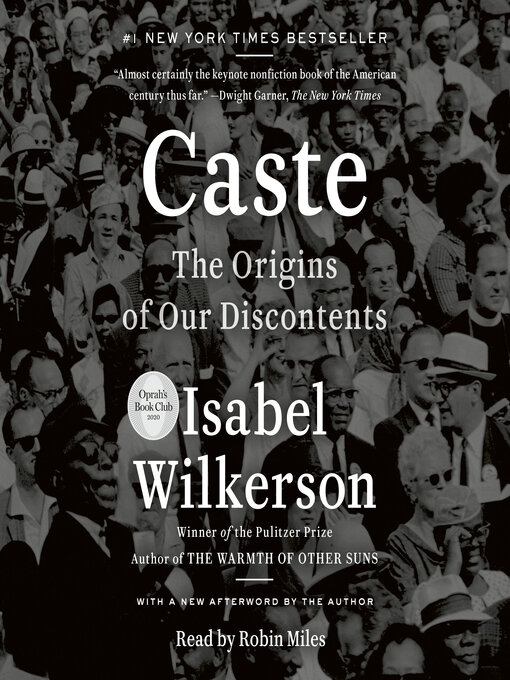
Title details for Caste by Isabel Wilkerson - Available

Caste

The Origins of Our Discontents

Audiobook
2 of 3 copies available
#1 NEW YORK TIMES BESTSELLER • NEW YORK TIMES READERS PICK: 100 BEST BOOKS OF THE 21st CENTURY • OPRAH’S BOOK CLUB PICK • “An instant American classic and almost certainly the keynote nonfiction book of the American century thus far.”—Dwight Garner, The New York Times
The Pulitzer Prize-winning author of The Warmth of Other Suns examines the unspoken caste system that has shaped America and shows how our lives today are still defined by a hierarchy of human divisions—now with a new Afterword by the author.
#1 NONFICTION BOOK OF THE YEAR: Time
ONE OF THE BEST BOOKS OF THE YEAR: The Washington Post, The New York Times, Los Angeles Times, Boston Globe, O: The Oprah Magazine, NPR, Bloomberg, The Christian Science Monitor, New York Post, The New York Public Library, Fortune, Smithsonian Magazine, Marie Claire, Slate, Library Journal, Kirkus Reviews
Winner of the Los Angeles Times Book Prize • National Book Critics Circle Award Finalist • Winner of the Carl Sandburg Literary Award • Dayton Literary Prize Finalist • PEN/John Kenneth Galbraith Award for Nonfiction Finalist • PEN/Jean Stein Book Award Finalist • Kirkus Prize Finalist
“As we go about our daily lives, caste is the wordless usher in a darkened theater, flashlight cast down in the aisles, guiding us to our assigned seats for a performance. The hierarchy of caste is not about feelings or morality. It is about power—which groups have it and which do not.”
Beyond race, class, or other factors, there is a powerful caste system that influences people’s lives and behavior and the nation’s fate. Linking the caste systems of America, India, and Nazi Germany, Isabel Wilkerson explores eight pillars that underlie caste systems across civilizations, including divine will, bloodlines, stigma, and more. Using riveting stories about people—including Martin Luther King, Jr., baseball’s Satchel Paige, a single father and his toddler son, Wilkerson herself, and many others—she shows the ways that the insidious undertow of caste is experienced every day. Finally, she points forward to ways America can move beyond the artificial and destructive separations of human divisions, toward hope in our common humanity.
  • Creators

  • Publisher

  • Awards

  • Release date

  • Formats

  • Languages

  • Reviews

    • Publisher's Weekly

      Starred review from June 29, 2020
      In this powerful and extraordinarily timely social history, Pulitzer winner Wilkerson (The Warmth of Other Suns) investigates the origins, evolution, and inner workings of America’s “shape-shifting, unspoken” caste system. Tracking the inception of the country’s race-based “ranking of human value” to the arrival of the first slave ship in 1619, Wilkerson draws on the works of anthropologists, geneticists, and social economists to uncover the arbitrariness of racial divisions, and finds startling parallels to the caste systems of India and Nazi Germany. The Nazis, Wilkerson notes, studied America’s restrictive immigration and anti-miscegenation laws to develop their own racial purity edicts, and were impressed by the “American custom of lynching” and “knack for maintaining an air of robust innocence in the wake of mass death.” While India abolished formal laws that defined its caste systems in the 1940s, and America passed civil rights measures in the ’60s, their respective hierarchies live on, Wilkerson writes, in “hearts and habits, institutions and infrastructures.” Wilkerson cites studies showing that black Americans have the highest rates of stress-induced chronic diseases of all ethnic groups in the U.S., and that a third of African Americans hold antiblack biases against themselves. Incisive autobiographical anecdotes and captivating portraits of black pioneers including baseball pitcher Satchel Paige and husband-and-wife anthropologists Allison and Elizabeth Davis reveal the steep price U.S. society pays for limiting the potential of black Americans. This enthralling exposé deserves a wide and impassioned readership. Agent: Amanda Urban, ICM Partners.

    • BookPage
      In The Warmth of Other Suns, Pulitzer Prize-winning journalist Isabel Wilkerson eloquently traced the lives of the 6 million Black Americans who fled the Jim Crow South during the Great Migration. Never once in that 640-page book did she mention the word racism. “I realized that the term was insufficient,” she explains. “Caste was the more accurate term.” Her latest book, Caste: The Origins of Our Discontents, is a much anticipated follow-up and couldn’t be timelier. In it, she examines the “race-based caste pyramid in the United States,” comparing this sociological construction to two other notable caste systems: those of India and Nazi Germany. “As we go about our daily lives,” Wilkerson writes, “caste is the wordless usher in a darkened theater, flashlight cast down in the aisles, guiding us to our assigned seats for a performance. The hierarchy of caste is not about feelings or morality. It is about power—which groups have it and which do not.” Wilkerson’s comparisons are profound and revelatory. Chapters describe what she has identified as “the eight pillars of caste,” the methods used to maintain this hierarchy, such as heritability, dehumanization and stigma, and control of marriage and mating. In addition to such insights, including how immigrants fit into the caste system, what makes this book so memorable is Wilkerson’s extraordinary narrative gift. Highly readable, Caste is filled with a multitude of stories, many of which are tragically familiar, such as those of Trayvon Martin and Freddie Gray. The story of Sergeant Isaac Woodard Jr. is particularly shattering. Returning home on a Greyhound bus after serving in World War II, Woodard asked the driver to allow him to step off the bus to relieve himself, but the driver refused. When Woodard protested, the driver called the police and had him arrested. The police chief, in turn, blinded the returning soldier with his billy club. Stories like these are painfully informative, making the past come alive in ways that do not beg but scream for justice. That said, Wilkerson is never didactic. She lets history speak for itself, turning the events of the past into necessary fuel for our current national dialogue. Dismantling the caste system is possible. Wilkerson points out that Germany did it after World War II. But in the meantime, “caste is a disease, and none of us is immune.” If you read only one book this year, make it Caste, Wilkerson’s outstanding analysis of the grievances that plague our society.   ALSO IN BOOKPAGE: Love audiobooks? Check out Caste and other nonfiction audiobook picks.

Formats

  • OverDrive Listen audiobook

Languages

  • English

Loading
